
Designing a daily puzzle people actually return to
The small choices that turn a one-off clever puzzle into a daily habit worth keeping, and the ones we got wrong first.
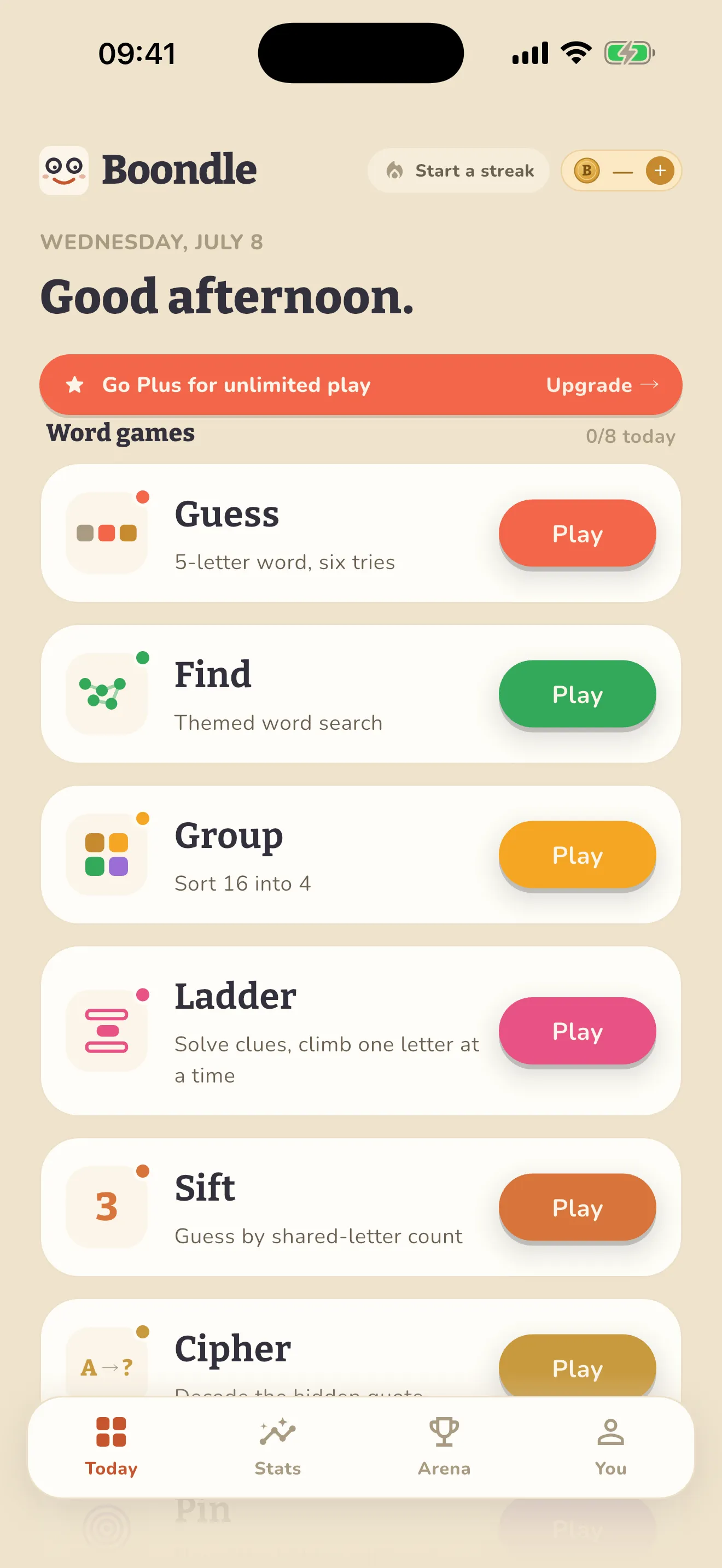
Making one good puzzle is not that hard. Making a puzzle someone wants to come back to every single morning, without being nagged into it, is a completely different problem. The cleverness of any single day matters far less than the shape of the habit around it. Boondle is built from small daily games (Guess, Group, Ladder, Cipher), and most of the design work went not into the puzzles themselves but into the frame they sit in. Here is what we learned, including the things we got plainly wrong to begin with.
One puzzle a day, and only one
The single most important decision was to give you one of each puzzle a day, and then stop. When it is done, it is done, and you come back tomorrow. This feels almost rude the first time, especially now, when most apps are built to hold on to you for as long as they possibly can. It is also the whole point. Scarcity is what turns a game into a ritual. A puzzle you can play a hundred times in a row is a way to kill an afternoon. A puzzle you get one shot at, refreshed every midnight, is a ritual, and a small, reliable ritual is exactly the kind of thing a person builds into their morning.
Everyone gets the same puzzle
The second decision followed from the first. Everyone plays the same puzzle on the same day. Not a difficulty tuned to you, not an endless personalised stream, the same grid your friend is grumbling about on the other side of the country. This is what makes the result worth sharing at all. When you tell someone today’s Group was cruel, they know precisely which one you mean, because they suffered the same one. A daily puzzle is a social object at heart, and it only works as one if it is genuinely shared.
The result screen is the marketing
We spent a surprising amount of time on the screen you see after you finish, because that screen is doing more work than any advert we could afford. It had to capture how you did in a way that is fun to send to someone but gives nothing away, no answers, no spoilers, just the shape of your attempt. Get that right and players do the reaching for us, one group chat at a time. Get it wrong and every share spoils the puzzle for whoever receives it. That balance, expressive but spoiler-free, took more iterations than almost anything else in the app.
Streaks that reward, without punishing
Here is the first thing we got wrong. Our early streak counter behaved the way most of them do. Miss a single day and it dropped straight back to zero. It certainly drove people to come back, and it drove them back for exactly the wrong reason. A habit held together by dread of losing a number is not a habit anyone actually enjoys. The first time a tester lost a forty-day streak to a busy Tuesday, they did not feel motivated. They felt punished, and they stopped playing.
So we softened it. A streak should feel like something you are quietly proud of, not a hostage you are terrified of losing. We are far gentler about the odd missed day now, because the goal was never to trap anyone. It was to be a pleasant part of the morning. The moment a game starts feeling like an obligation, it has failed at the one job it had.
Difficulty is a week, not a day
The second thing we got wrong was tuning each puzzle in isolation, asking only whether today was fair. Played across a whole week, the run felt random. A brutal Monday, a trivial Tuesday, no rhythm to it. Players could not tell whether they were improving or just being tossed around by luck. Now we think about difficulty as a curve across the week rather than a property of a single day. Gentler starts, a proper challenge midweek, the occasional Sunday that makes you feel clever for finishing. The individual puzzle matters less than the arc it belongs to, and the arc is what makes a hard day feel earned instead of unfair.
Losing has to be all right
A daily game has a particular cruelty the ordinary sort does not. If you fail today’s Guess, there is no trying again for real. You wait until tomorrow. That raises the stakes of every failure, so how the game treats you when you lose matters enormously. It cannot gloat, and it cannot shrug either. It should show you the answer, let you feel the near miss if it was one, and point gently at tomorrow. Handle the loss with a bit of grace and people come back the next day. Handle it badly and a single bad morning is the last time they open the app.
None of this is about any one puzzle being brilliant. It is about the frame: one a day, shared by everyone, kind about failure, fun to talk about, gentle with your streak. Get the frame right and even an ordinary puzzle becomes part of someone’s morning. Get it wrong and the cleverest puzzle in the world gets uninstalled by Thursday.